
A STEP TOO FAR
First Chapter

Chapter 1
Port Macquarie 1828
Annie was eight years old when she lost her mother. Until then her childhood had been idyllic. Surrounded by love, both from her doting parents and from her older sister, Harriet, she was a happy and carefree child. She also enjoyed a strong tie with her younger brother, Henry, though he was more often annoying than loving.
Annie was named in memory of a close friend of her mother, Jane. Her mother told her all about it one day.
‘Do you want to know why I called you Annie, my darling?’
‘Yes, Mama. Please tell me.’
‘I had a dear friend called Annie whom I met back in England and I wanted to honour that friendship by giving you her name. It is a privilege to bear the name of someone dear. She showed me great love and compassion during the most trying of times.’
‘What happened to her? Does she live in Sydney?’ Annie knew that her mother had first landed there when she came to New South Wales.
‘No, she doesn’t. I’ll tell you. You know I was a convict?’
Annie nodded.
‘Well, so was Annie. We were both convicted of our crimes and sentenced to transportation to New South Wales for seven years. Because we were the same age and shared similar natures, we looked out for each other both during our time in Newgate Prison and during the voyage. But after leaving a place called Rio de Janeiro in South America, our ship struck stormy weather and Ann became seriously ill with melancholia. Do you know what that is?’
‘Yes, it’s when you get very sad.’
‘That’s right and I wasn’t able to help her. Then something truly dreadful happened. Unexpectedly she launched herself over the rail and did nothing to save herself. The waves crashed down on her, filling her heavy clothing with water and dragging her under. It was a terrible shock. I just stood there screaming but there was nothing I or anyone else could do. She was lost.’
Annie sat very still, her mouth open, staring at her mother. She had not expected to hear such an alarming story.
Jane hugged her, sensing her shock. ‘I know it’s a dreadful story but it really happened. The other women on deck tried to comfort me but I blamed myself. I felt I should have understood her pain and done more to help. I still think of her often and wish she was still here with me.’
Annie hugged her mother and stayed silent for a while. ‘Thank you for telling me, Mama. I shall always be very proud to have been called after her.’
-oOo-
Annie’s family was living in Port Macquarie when she was old enough to understand this story.
She had been born in Newcastle where her father, Tom, was a convict working at the sawmill. But when she was one year old, Tom received his Certificate of Freedom and was offered the post of sawmill superintendent on behalf of the government in Port Macquarie. This was to be the new penal settlement, further north than Newcastle. Tom accepted the position and went ahead of his family to help establish the town, specifically to erect the sawmill and build a house for his family to live in. Jane, Harriet and Annie joined him four months later.
It had been decided to shut down the penal settlement of Newcastle due to the large number of absconding prisoners. The government needed somewhere more remote to keep them and Port Macquarie had been chosen.
While Annie’s memories of that first house and life in the settlement were dim, those of their later years, when they had moved out onto land beside the river at Blackmans Point, were far sharper. Her father, now a free man and a valued member of the town, had applied to Governor Brisbane for a land grant there.
Brisbane had followed on from Governor Macquarie’s lead in rewarding hard-working men who had earned their freedom with small parcels of land. The allocation was generally thirty acres for a man, with an additional twenty if he was married, plus ten for every child. With his three children, Tom was entitled to eighty acres.
In due course, he had been allocated ninety acres of fertile farmland. Blackmans Point was upriver from Port Macquarie on the northern side. Here he built a sturdy house, set back from the water on a slight rise, and began cropping his land. This was something the government encouraged as they not only wished the settlement to become self-sufficient but wanted any surplus shipped south to the growing town of Sydney.
Now, seven years on, life was going well for the family. Recently Tom had taken a reduction in his wage at the lumberyard and now worked there only on two consecutive days a week, rowing down to town and staying overnight to fulfil those duties. One of his sawyers, another freed convict and a most able man, had moved up into Tom’s position and supervised operations on the days his boss was absent.
Harriet and Annie, now aged ten and eight, always accompanied him on these days so they could attend school. Henry would begin when he turned seven. Their teacher, Mr. McRoberts, had arrived in 1826 with his wife who helped out by teaching the girls needlework. McRoberts had been a soldier in Sydney and had been granted his discharge on the proviso that he serve as a schoolmaster somewhere for five years.
Tom was a firm believer in education and every day whether the girls were with him in the lumberyard or at home on the farm, he always made sure he kept their minds active by giving them mental arithmetic problems to solve and ensuring they practised their reading from the Bible each evening.
Port Macquarie was growing. A road on the southern side of the river now led into town and a ferry service from Blackmans Point was soon to be in operation. This would make accessing the town far easier for the Wylde family.
During her younger years, Annie was a little less inclined to school than her sister. It was not that she was less able but more that her interests lay elsewhere. Nothing made her happier than joining her father in the lumberyard when lessons were over for the day or going with him on the rare occasions when he was persuaded to take her upriver with him to check on the timber-getting gangs. Annie enjoyed using her hands and Tom could easily see her working on the land when she was older.
On the farm days, Annie worked alongside Harriet helping their mother with the family’s market garden. She had a love of watching plants and animals grow. When not at work with her sister, she was more willing than Harriet to help her father with the weeding and watering of the wheat and corn crops he had planted. She also learned to milk. Her father had purchased two goats and the nanny had recently produced a kid which meant the family had a supply of fresh milk.
Whilst Annie worked alongside her father, Harriet readily helped their mother with the domestic chores while young Henry, at five years of age, was learning responsibility by feeding the chickens and collecting the eggs.
The whole family travelled to town once a week for divine service. During the four years it took to build the town’s St. Thomas Church, these services had been held in the open air on land beside the ongoing construction. Convict-made bricks and local timber were used and Tom was actively involved. When it finally opened in the February of 1828, the family sat proudly in one of the beautiful hand-crafted pew boxes he had made from selected cedar logs. The building had been completed the year before but the settlement had needed to await the arrival from Windsor of their new minister, the Reverend John Cross, before it could be officially opened.
On that all-important day, the morning Divine Service was packed with most of the one-hundred-and-fifty-odd free settlers of Port Macquarie who lived within five miles of the church. Many of these returned for the afternoon service as they had eagerly anticipated their new pastor’s arrival and wanted him to know he was very welcome. Nearly all the convicts sat on the grassy hillock outside and around thirty natives also gathered to listen, too shy to come inside. The large numbers delighted Parson Cross, as he soon came to be called, and he spent time addressing both the convicts and the natives at the conclusion of the morning service.
Some weeks later, Harriet, Annie and Henry were delighted when their mother told them that they were soon to have another baby brother or sister. Annie was especially excited by the prospect but her anticipation was somewhat dampened by her father’s reticence and, as the months passed, his growing sense of unease. Not understanding the perils of childbirth and unaware of her mother’s past difficulties, she was perplexed by his lack of enthusiasm.
She turned to her mother for reassurance, something Jane willingly gave.
‘You musn’t worry your sweet head, Annie. Women have babies all the time and I will come through this one exactly as I did with you and Harriet and Henry.’
‘Then why is Dadda so worried?’
‘Fathers always worry about such things. To ease his mind I have agreed to stay in Port Macquarie during my final weeks. I will have a convict midwife to help me and the support of my dear friend, Sarah Partridge. While I’m away you must stay here and help Harriet to look after your father and Henry and, when I come back, you will be able to help me care for your new baby sister or brother.’
‘What shall we call the baby, Mama?’
‘What do you suggest, Annie?’
‘I rather like Maggie if it’s a girl.’
‘I do too. Maggie it shall be. But what of a boy’s name? I was thinking of Tom after your Dadda.’
‘Yes. That’s a good name. It will be Maggie or Tom.’
Four weeks after that conversation and four weeks before her due time, Jane went into labour. She woke her husband.
‘Tom, I am not going to make it into town to have this baby. It has decided to come tonight.’
Tom was instantly awake, the unwelcome news banishing any thought of further sleep. He lit a candle and placed it beside the bed.
‘Are you sure, Jane? I could have you down to the town in less than an hour. I know the tide would be with us.’
She shook her head. ‘No, Tom, my pains are coming a few minutes apart. I will have to birth this baby here.’
Tom’s face must have shown his anguish.
She took his hand. ‘It will be all right, darling. I’ve done this three times before. I’ll tell you what to do.’
Tom dressed swiftly, stoked the fire in the living room and added a fresh log. Thankfully the three children did not stir. Jane directed him to set water to boil, take out some fresh linen, locate the scissors and cut two lengths of twine. When all was in readiness, she sat him down beside her and explained, between her contractions, what he would need to do.
The pains became more intense. Jane asked Tom to fetch her a stick that she could bite down on during the worst of the contractions and she began panting in between each one. She moved her hand down between her legs and her fingertips touched a soft downy head.
‘Not long now,’ she managed before putting all her effort into another push.
Tom threw back the cover and placed a wide strip of linen under her. On the next push, the baby’s head appeared.
‘It’s coming, Jane. Another push and it should be out. Are you coping?’
Jane didn’t answer, instead using all her energy to push down.
The baby slithered out and Tom was ready to wipe it down and hold it by the legs exactly as Jane had instructed. ‘It’s a wee girl,’ he told her.
The baby took her first lungful of air and offered a weak cry. Tom laid her on Jane’s belly and steered the tiny mouth onto his wife’s nipple.
‘Well done, Tom,’ Jane said. ‘Now pick up the twine and tie it off firmly in two places. It must be firm to prevent any bleeding. Dip the scissors in the boiling water before cutting the cord.’ Jane used one hand to hold her baby in place and the other to gently massage her stomach. ‘My afterpains will come next and the afterbirth should come away.’
Tom did as he had been instructed and cut the cord.
At that moment, a sharp pain tore through Jane and she cried out.
‘What is it? What’s wrong?’ Tom asked.
‘The afterbirth… it’s torn away… I’m bleeding…’
Tom lifted the baby off Jane’s chest and laid it on the bed beside her. He began wiping away the blood that appeared to be pulsing out of Jane. ‘Jane, help me! What do I do?’
‘Push the linens up inside me. It may help staunch the flow.’
The action did seem to have the desired effect and the blood flow did ease. Jane fell asleep and Tom wrapped his new baby and set her in the crib. He remained by Jane’s side, watching every rise and fall of her chest and praying to God that she would survive the night.
The children woke the next morning to the news that they had a baby sister and Tom asked Harriet and Annie to wash and dress her.
‘Her name is Maggie,’ Annie told her father. ‘It’s what Mama and I decided.’
‘Did you now? Then Maggie it is,’ Tom declared. ‘Harriet, when you have finished with Maggie can you prepare some breakfast and, Annie, can you help your brother to dress, please?’
‘I can do it myself,’ Henry retorted. ‘I’m not the baby anymore.’
‘No, indeed you are not.’ Tom smiled down at his young son and ruffled his hair affectionately.
Jane woke from her sleep and appeared to be recovering. The bleeding had all but stopped and she was keen to feed the baby and greet her older children. All three were very excited by Maggie’s arrival. By nightfall, Jane had regained her colour and announced that she believed she was over the worst.
Tom relaxed a little but was awakened in the early hours of the morning by Jane asking for water.
She had developed a fever and, by the time the jackasses heralded the dawn, her body was burning up. Her face was bright red and beads of sweat were on her brow.
‘Harriet, look after your mother and the children. I’m going into town to fetch the doctor.’ Tom launched his small rowboat and took off with an ebb tide helping him along. Fortunately he found Doctor McIntyre at his residence and, after the doctor had arranged for someone to come and fetch him later, set off with Tom on the return journey, both taking an oar.
The doctor diagnosed childbed fever and could do little to help. He prescribed continued bed rest and plenty of fluids, telling Tom that the infection would have to run its course and that it was a fairly common occurrence after childbirth. He didn’t need to add that her chances of pulling through were slim.
Jane fell asleep that night with Tom’s hand in hers.
As dawn was breaking, Tom awoke from a fitful sleep to find Jane’s hand still in his but cold and lifeless. Distraught, he laid his head on her breast seeking the reassurance of a heartbeat. Finding none, he wept silently, only raising his head when he felt the eyes of his three older children upon him. They had crept soundlessly into the room, not wanting to believe what was before them.
‘Dadda, what’s wrong? Is Mama still asleep?’ Annie asked tentatively.
‘Oh, my darlings, it is the worst of all news. Come here to me.’ He held his arms wide and the three children rushed into his embrace.’
‘Your beautiful Mama has left us. She has gone to be with the Lord.’
Annie’s heart wanted to burst with the pain. ‘No, Dadda, that can’t be right! Mama told me she would be fine. That you were worrying for nothing.’
Tom’s eyes filled with tears again as he tried to comfort his young daughter. ‘She is at peace now, my darling.’
Annie shook her head, refusing to accept the news, the shock too immense. How could this be? Her mother had reassured her that all would be well. Still shaking her head, she wriggled out of her father’s grasp and ran outside, breathing in great gulps of air as she shook with rage. Mama cannot be dead. She simply cannot be.




Other Adult Books by Dell that you may like…
-
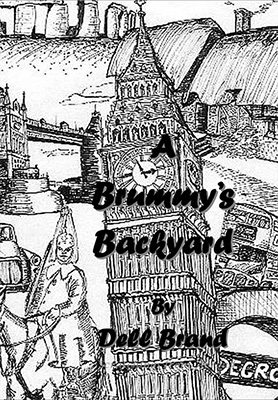 As the lumbering jet swoops low over the grey, legoland housing rows that surround Heathrow Airport, the story of the author’s year of living in England begins. Recipients of a teaching exchange, Australians Dell and John are bound for schools in the West Midlands, and find that things are quite different in Brummyland.
 -
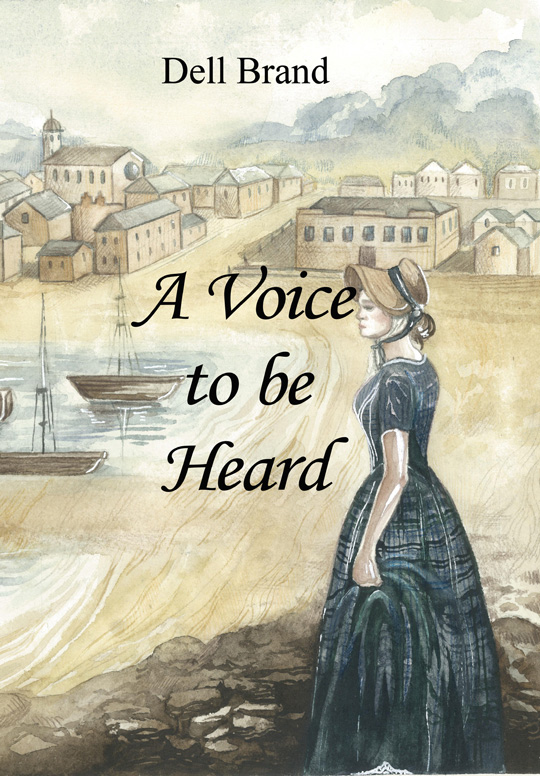 The story of two young women determined to live outside the confines of the Victorian Age and who have a lasting impact on the fledgling town of Melbourne.
 -
 An epic story of life and death amid the turbulent years of the Victorian gold rush, narrated by the three main characters, Adam, Joey and Tom.
 -
 Penny Taylor, from London’s East End, finds herself part of the struggling Hapless family, living in a caravan park in the Illawarra on the south coast of New South Wales. She is kept busy with three young children, two of whom belong to Dudley Hapless, her present partner and a professional basketball player with the Hawks.